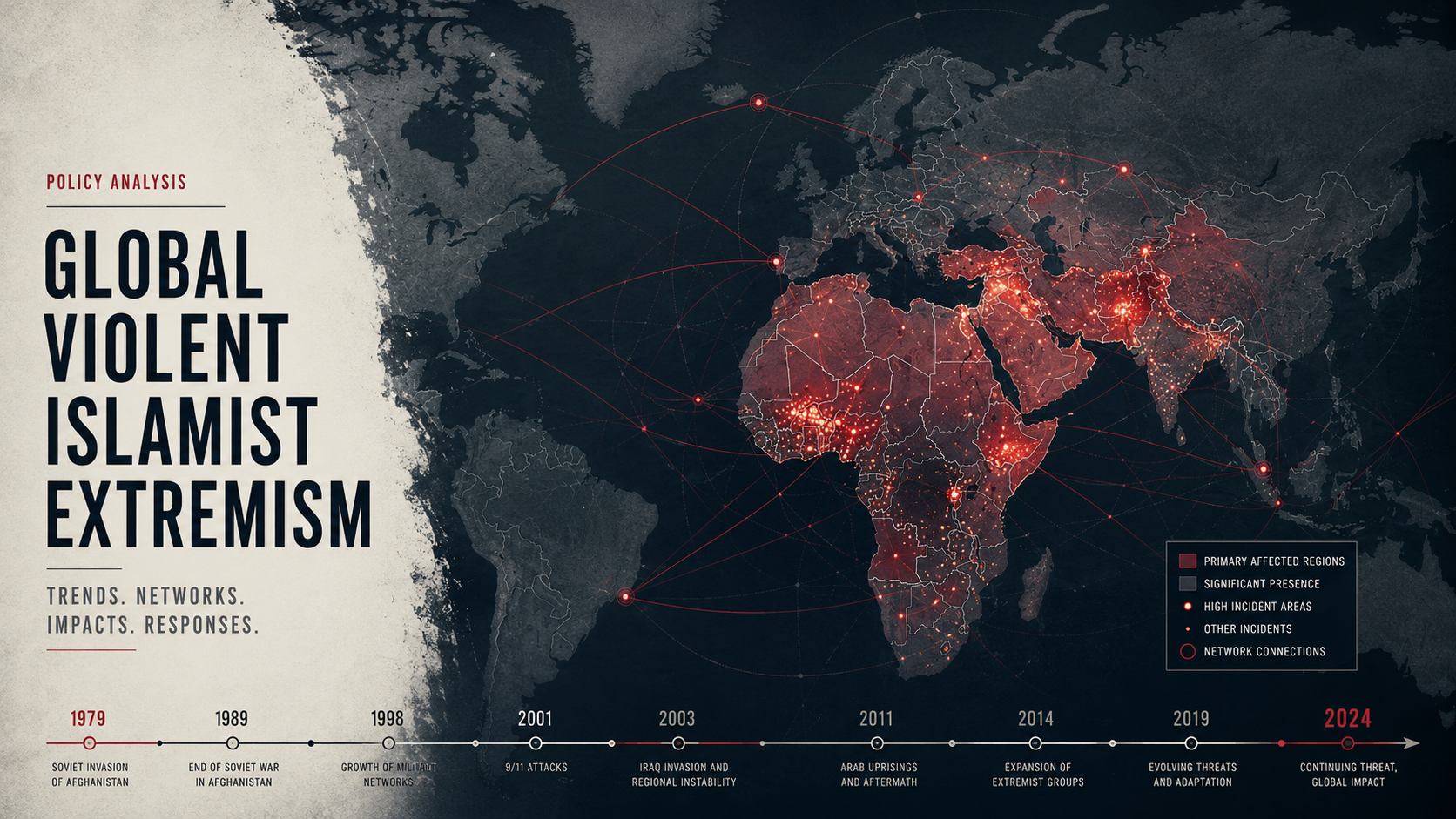
If policymakers still talk about Islamist terrorism as a post-9/11 legacy problem rather than a present-tense threat, they are reading the wrong trend lines.
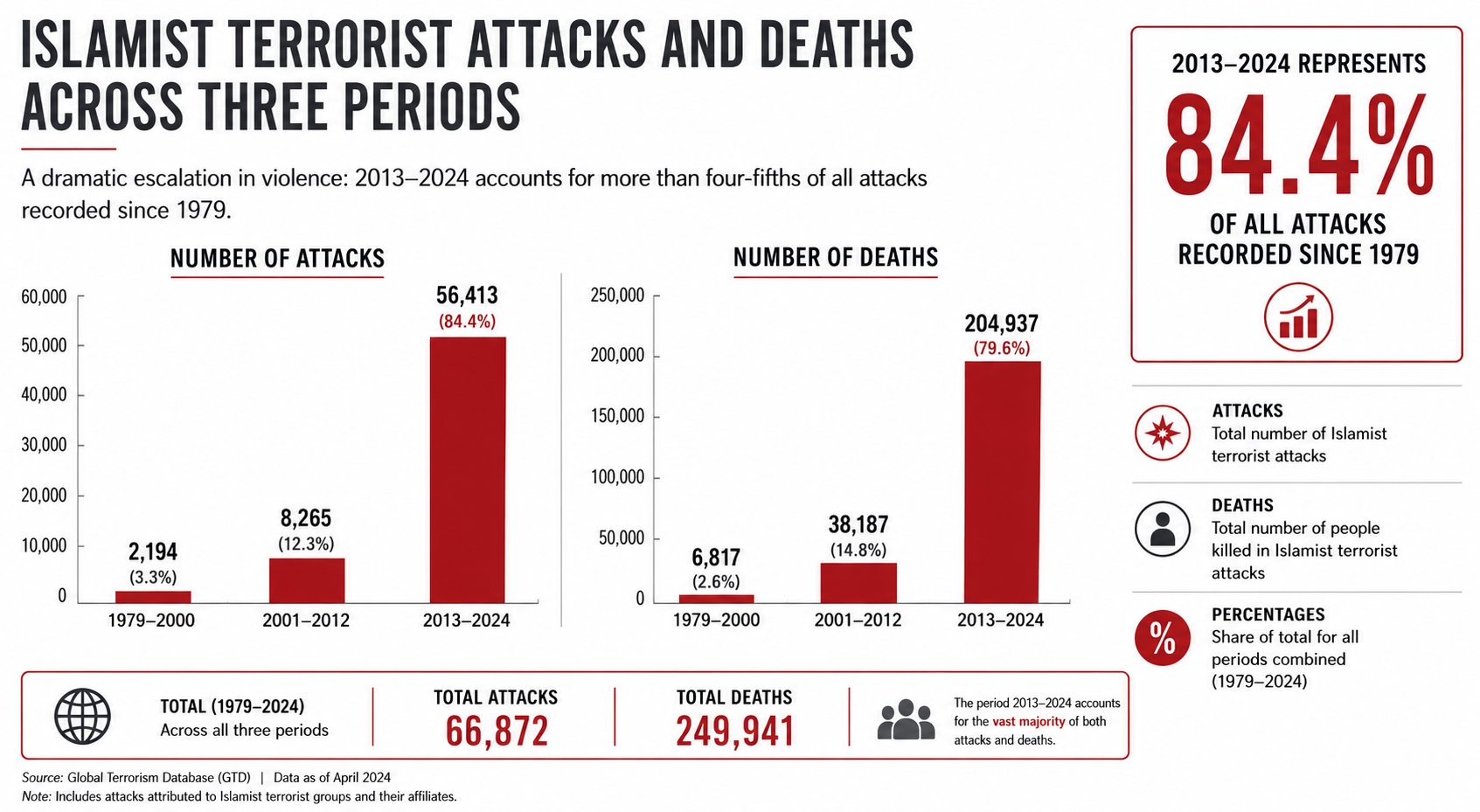
The latest Fondapol edition, covering 1979 to April 2024, records 66,872 Islamist terrorist attacks and at least 249,941 deaths worldwide. More importantly, the recent period dominates the total: from 2013 to April 2024 alone, the study records 56,413 attacks and 204,937 deaths. That is 84.4% of all recorded attacks in the full period.
This is not a historical footnote. It is an ongoing, adaptive security challenge.
At the same time, precision matters. Violent Islamist extremism is a political ideology and insurgent strategy; it is largely claimed to not be synonymous with Islam or with Muslim populations but evidence shows extremism is creeping in to all parts of Islam. Looking at cases in the UK, Moussa Khadri was regarded as a “peacful man” who took the extreme action of attacking a member of the public with a knife in broad daylight for burning the Quran, this behaviour is becoming normalised. The same dataset, however, shows that most victims are in Muslim-majority countries, which directly contradicts some of the civilizational framing and underlines who is bearing the human cost.
What The Data Says Right Now
From the Fondapol study:
- Average lethality is high: 3.7 deaths per attack.
- The violence is geographically concentrated: 96.7% of attacks occurred in the Middle East and North Africa, South Asia, and Sub-Saharan Africa.
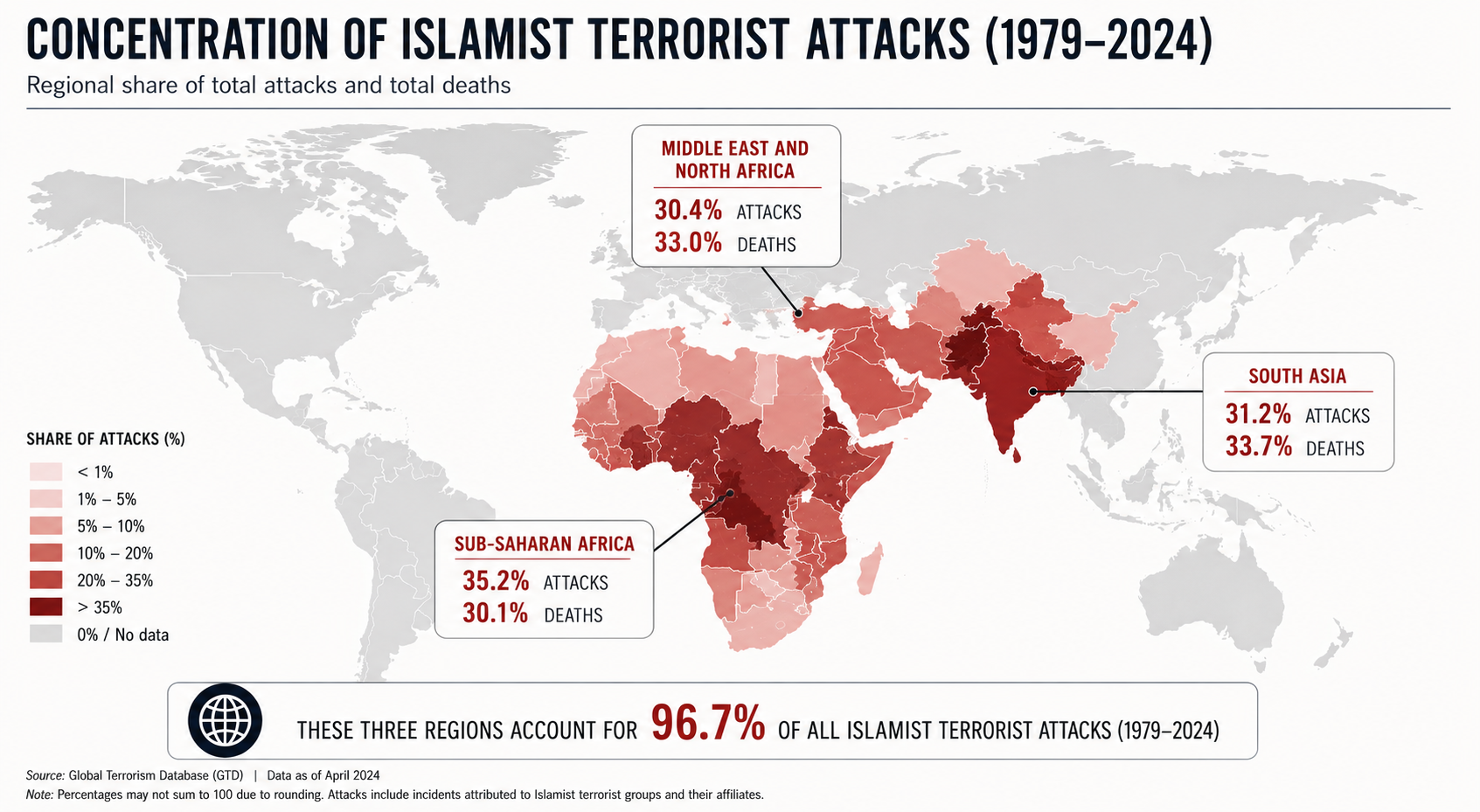
- The burden is heavily concentrated in a small set of countries: Afghanistan, Somalia, and Iraq lead by number of attacks.
- Targeting patterns are strategic: military targets (34%), civilians (27.7%), and police (15.3%).
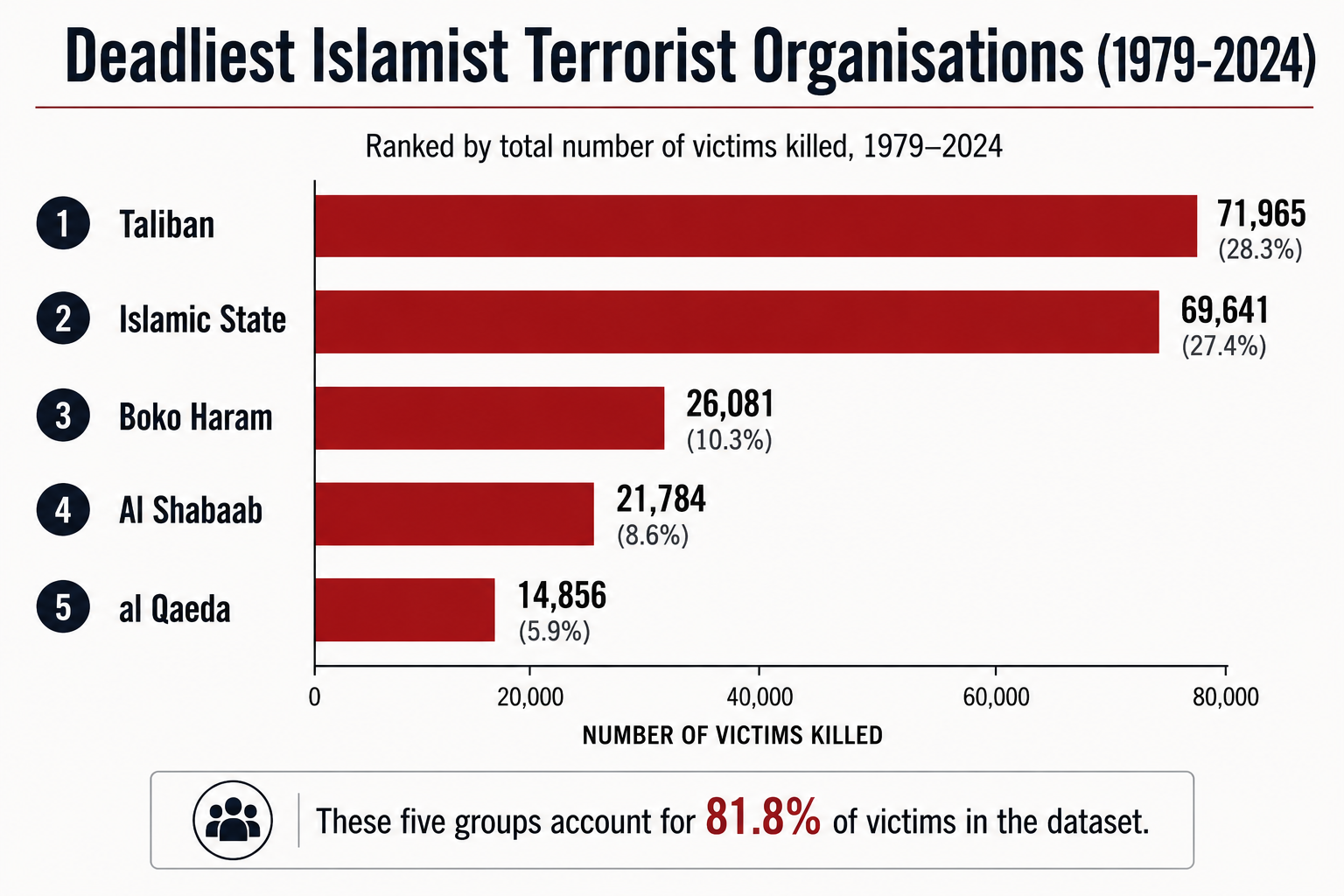
- Five organisations account for most deaths: Taliban (71,965), Islamic State (69,641), Boko Haram (26,081), Al Shabaab (21,784), al Qaeda (14,856). Together, they account for 81.8% of victims in the dataset.
The strategic implication is straightforward: this is not random background violence. It is sustained, networked, and organisationally durable.
Why This Is A Current Danger
Three features of the threat environment stand out.
First, persistence. The post-2013 period is not a temporary spike that naturally burned out. It represents a durable phase where multiple theatres remain active at once.
Second, diffusion across weak-governance zones. The strongest growth has been in places where state authority is fragmented, borders are porous, and local grievances can be fused with transnational ideological narratives.
Third, operational variety. Firearms and explosives remain dominant, but attack methods and target sets are mixed, forcing security services to defend both hard and soft targets simultaneously.
None of this supports complacency. It supports targeted prevention, intelligence cooperation, financial disruption of networks, and long-horizon resilience planning.
Policy Priorities That Follow From The Evidence
If the goal is to reduce attack volume and lethality, policy should emphasize:
- Intelligence fusion across domestic and transnational channels.
- Sustained disruption of recruitment and propaganda pipelines, especially in digital spaces.
- Protection of repeatedly targeted institutions (military, police, transport, civilian crowd locations).
- Serious partnership with local communities and credible civil society actors.
- Clear distinction between counter-extremism and broad religious suspicion, which is both unjust and strategically counterproductive.
Good security policy is specific, evidence-based, and disciplined. It avoids both denial and demagoguery.
Source
Primary source: Fondapol, Islamist terrorist attacks in the world 1979-2024 (October 2024, data through 12 April 2024).
URL: https://www.fondapol.org/en/study/islamist-terrorist-attacks-in-the-world-1979-2024/
Note on interpretation: the study itself states its figures likely underestimate the full reality because of data limitations in some contexts.
Comments
Comments are reviewed before they appear publicly.
By submitting a comment, you acknowledge that your IP address is recorded for moderation and abuse prevention.
Loading comments...